Would Botticellis Birth of Venus Be Classified as an Abstract Work if Art
Born from seafoam in adult form, arriving on the shores of Paphos (or some say Kythera) in Greece on a seashell. You would retrieve this is a story from a fantasy novel, just this is the arrival of the Roman Goddess, Venus, just after she was born. This is also the subject matter of the famous Birth of Venus painting past Renaissance artist Sandro Botticelli, which we volition discuss in this article.
Tabular array of Contents
- 1 Artist Abstract: Who Was Alessandro Botticelli?
- 2 The Birth of Venus past Alessandro Botticelli in Context
- 2.1 Contextual Assay: A Brief Socio-Historical Overview
- 3 Formal Analysis: A Brief Compositional Overview
- 3.1 Subject Matter
- 3.2 Technique: Color and Light
- 3.iii Perspective and Line
- three.four Proportions
- iii.5 Scale
- 3.six Stylistic Influences
- 3.7 Symbolic Interpretations
- four A Circuitous Beauty
- v Ofttimes Asked Questions
- 5.1 Who Painted The Nascence of Venus?
- 5.2 When Was The Birth of Venus Painted?
- 5.3 Where Is The Nascence of Venus?
- 5.4 Where Was The Nativity of Venus Painted?
Artist Abstruse: Who Was Alessandro Botticelli?
Alessandro di Mariano di Vanni Filipepi, or but Sandro, Botticelli was born in Florence in Borgo Ognissanti. He was born betwixt 1444 and 1446 and died in May 1510. He was one of the leading Italian artists that worked during the Early Renaissance period. He worked equally a goldsmith in his early life and was an apprentice to Fra Filippo Lippi.
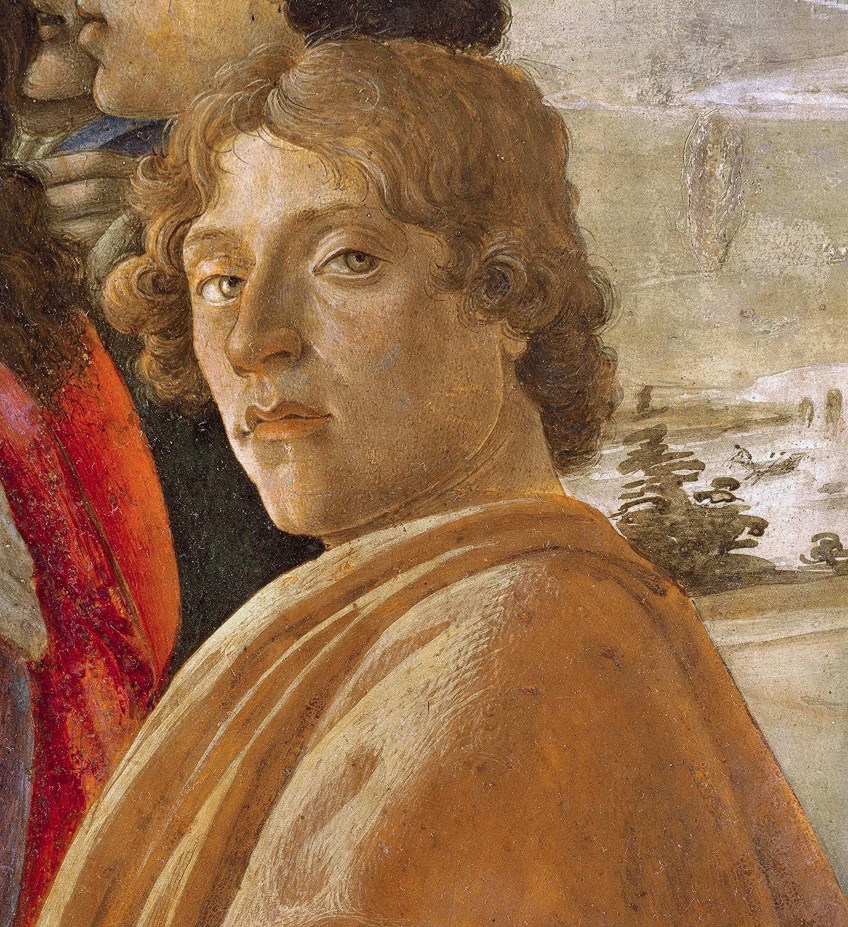 A self-portrait of Sandro Botticelli in his painting Adoration of the Magi (c. 1475);Sandro Botticelli, Public domain, via Wikimedia Eatables
He was commissioned by wealthy families of Florence like the Medici family. Pope Sixtus Iv also commissioned him to paint part of the Sistine Chapel. Botticelli painted religious and mythological field of study matter. His famous artworks include La Primavera (c. 1482 to 1483), Venus and Mars (c. 1483), and The Birth of Venus (c. 1484 to 1486).
The Nascence of Venus by Alessandro Botticelli in Context
The Nativity of Venus painting past Alessandro Botticelli is one of the most famous mythological paintings from the Early on Renaissance period. Although Sandro Botticelli was not as popular as other artists from the Renaissance, such as Leonardo da Vinci or Michelangelo, he still contributed one of the well-nigh beautiful and sensory-enriching paintings of the goddess Venus.
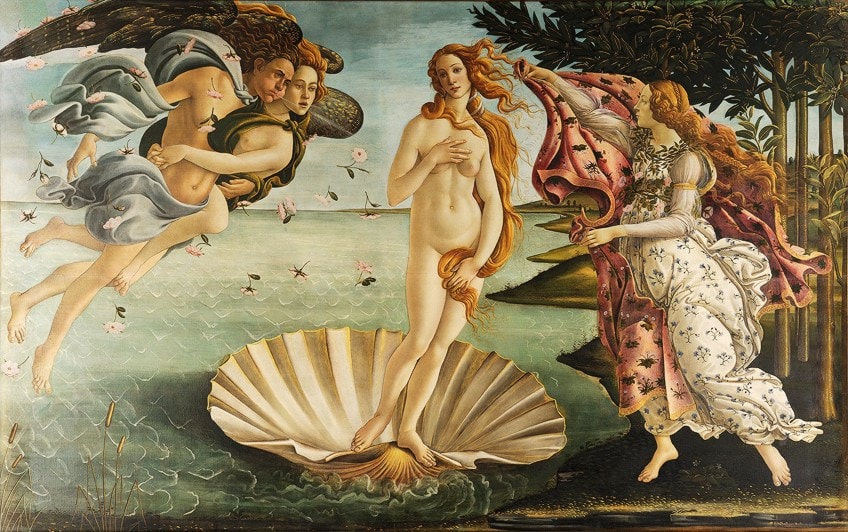 The Nativity of Venus (c. 1485) by Sandro Botticelli; Sandro Botticelli, Public domain, via Wikimedia Commons
Below, we will await at the Birth of Venus analysis, starting with a contextual overview of the period surrounding the painting, namely the Early on Renaissance (also referred to as the Quattrocento menses). Nosotros volition conduct a full exposé of this famous painting and answer various related questions like, who painted The Birth of Venus? When was The Nativity of Venus painted? Where was The Nascence of Venus painted? Where is The Nascency of Venus? Who Venus was equally a mythological goddess? We will then discuss the stylistic influences on and approaches taken by Botticelli.
| Artist | Alessandro Botticelli |
| Engagement Painted | c. 1484 to 1486 |
| Medium | Tempera on canvas |
| Genre | Mythological history painting |
| Menses | Early Renaissance |
| Dimensions | 1.72 x two. 78 meters |
| Series / Versions | It has been believed that it was part of the other painting, La Primavera (c. 1482 to 1483), but it has been reported that it was non its analogue. |
| Where Is Information technology housed? | Uffizi Gallery, Florence, Italy |
| What Information technology Is Worth | Estimated around $500 million |
Contextual Assay: A Brief Socio-Historical Overview
The Birth of Venus painting was created during the 1400s, which was a menstruation in European history that saw a lot of cultural and economic changes. Notable changes that took place during this time included the ending of feudalism, which changed the European economic and social mural. This was a transitionary period from the Middle Ages (Medieval menstruum) and art styles progressed from Byzantine to Romanesque and and so Gothic.
This progression led to the starting time of the Renaissance, starting with the Proto-Renaissance and then the Early Renaissance. Understandably, a lot of the prior fine art styles withal lingered as the Early Renaissance period became more rooted in newer ways of thinking about life and the individual within the earth.
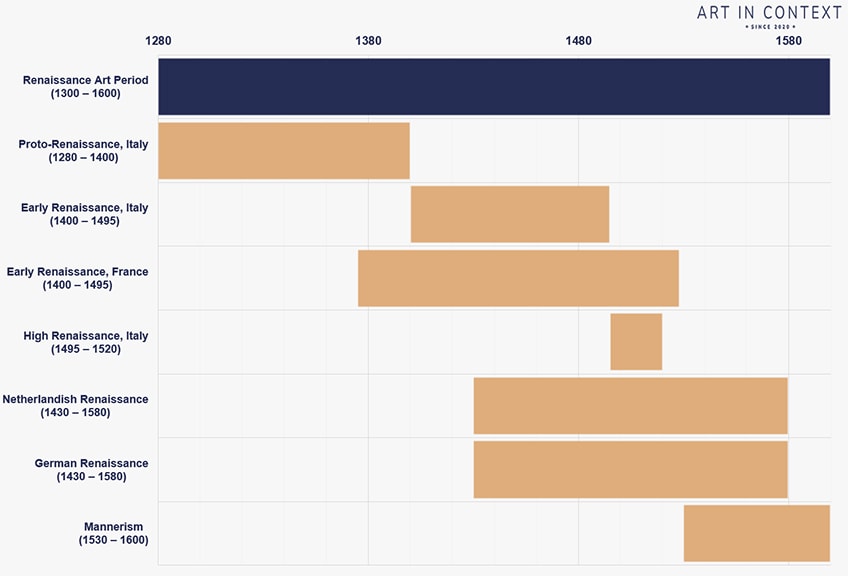 A timeline of the Renaissance catamenia.
At that place was a marked departure in the mode artists started painting too, gradually moving away from the flatter, two-dimensional, idealized, and iconographic Byzantine styles. Artists similar Cenna di Peppi (Cimabue) and Giotto di Bondone started portraying more naturalistic subject affair.
These new approaches also made art appear more 3-dimensional.
The Renaissance motility took place in Italy and Northern Europe, however, the Early Renaissance predominantly occurred in Florence and and then Rome during the later years. It was spearheaded by wealthy families, especially the Medici family. They were as well avid patrons of the arts and commissioned various artists, including Botticelli, to produce artworks for them.
It is believed that a member of the Medici family commissioned Botticelli to paint The Birth of Venus. Specifically, Lorenzo di Pierfrancesco de Medici, who was a broker and pol and the cousin of Lorenzo the Magnificent, or Lorenzo il Magnifico.
 Portrait of Pierfrancesco de' Medici (1463–1503), called Lorenzo il Popolano;Cristofano dell'Altissimo, Public domain, via Wikimedia Commons
It is likewise believed that Lorenzo il Magnifico commissioned Botticelli'southward other paintings Pallas and the Centaur (c. 1482) and La Primavera (c. 1482 to 1483) equally function of a hymeneals gift for his cousin. At that place is argue every bit to who exactly commissioned these paintings.
The Nascence of Venus painting was also painted on canvas, which was one of the first of this type of medium used for painting. Well-nigh paintings were done on wooden panels, but canvases became more pop because they were cheaper.
Paintings done on canvases were likewise mainly displayed in homes or villas compared to public buildings.
Therefore, The Birth of Venus was made for habitation brandish, possibly for the Villa di Castello, which belonged to Lorenzo di Pierfrancesco de Medici in 1486. This is also where La Primavera (c. 1482 to 1483) was housed.
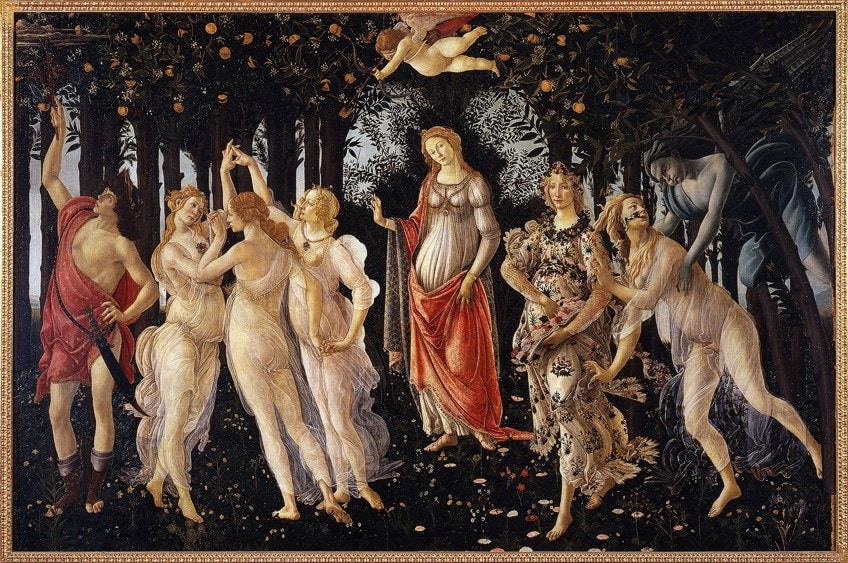 La Primavera ('Spring', 1480) by Sandro Botticelli;Sandro Botticelli, Public domain, via Wikimedia Commons
Even so, it is important to annotation that the Italian art historian Giorgio Vasari saw the in a higher place-mentioned paintings at Castello in 1550. An inventory reportedly discovered in 1975 indicated La Primavera recorded in it, simply not The Nascency of Venus. Therefore, it is not completely validated who exactly commissioned these paintings or where they were initially housed.
The Nativity of Venus was also painted within the context of the pop literature of the time, specifically that of Ovid's Metamorphoses (8 AD), Homer'due south writings, and Agnolo (Angelo) Poliziano's Stanze per la Giostra (1478).
Botticelli was believed to have been influenced by Poliziano because both had some sort of involvement with members of the Medici family at the time.
This too points to a broader feature of the flow at the time, which is a new manner of thinking and perceiving human being within the world. With the progression of the Renaissance, the Humanist motion gradually emerged. This was based on philosophical thought rooted in the revival of aboriginal Classical texts from the Greek and Roman cultures.
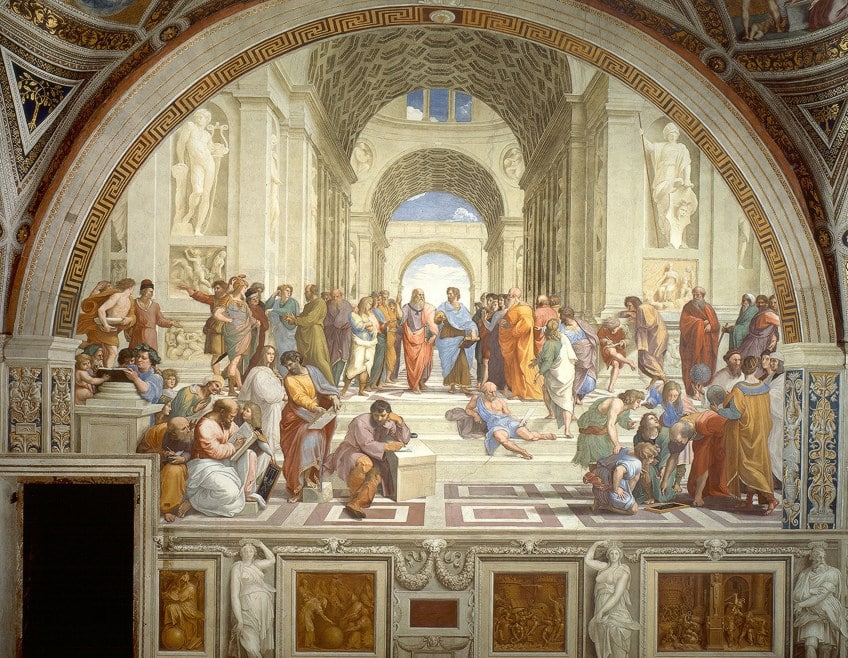 The School of Athens (1509–1511) by Raphael, depicting many notable artists, philosophers, and other figures from the Renaissance menstruum; Raphael, Public domain, via Wikimedia Commons
Artists, scholars, and many others were more open up-minded about different topics other than strict religious tenets that existed during the Middle Ages. Human being's capabilities were beingness questioned inside the larger aspects or macrocosm of that which was considered the universe.
Different spheres of knowledge were explored and studied, including concepts similar Neo-Platonism, which were based on the philosophical writings of the Greek philosopher, Plato.
Who Was Venus?
Not only was The Birth of Venus by Botticelli a magnificent sail showcasing a mythological scene and fit for a country villa, but information technology as well showcased the outset figure of a nude female in full size. This has not been done since the times of antiquity. Nosotros know by the painting's title information technology was Venus, but who exactly was Venus?
From the many mythological poems from poets like Ovid, Homer, Hesiod, and Poliziano, to name a few, Venus was the Roman Goddess of love, dazzler, prosperity, sex, and many other attributes related to love. Her proper noun is in Latin, meaning "honey". Aphrodite was her proper noun in Greek mythology and where the Romans derived their goddess of love.
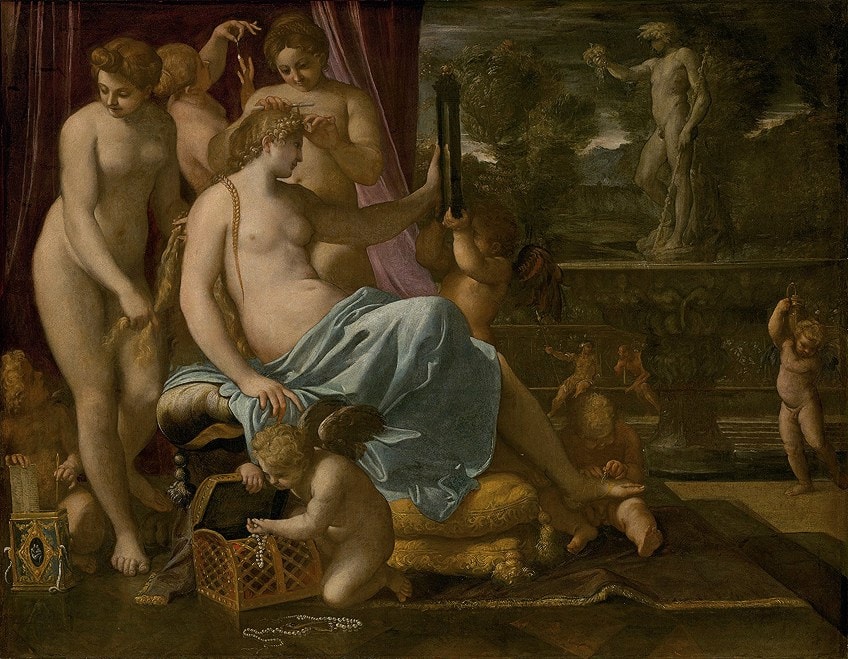 Venus Adorned by the Graces (1590/1595) by Annibale Carracci;National Gallery of Art, CC0, via Wikimedia Commons
Venus was built-in from the foam of the sea later her father, Uranus, was overthrown and castrated by his son Saturn. Uranus was amongst the fundamental gods in Greco-Roman mythology; he was the god of the sky. Saturn threw Uranus'south genitals into the sea, which mixed with the bounding main foam, thus giving birth to Venus. Venus' mother, therefore, was the sea. She was born fully grown.
When she was conceived and born in the sea, she was and so diddled by the god of the wind, Zephyrus, on a seashell. On the shore is the nymph Chloris, one of the goddesses of the seasons, who are collectively called the Horai.
Below, nosotros hash out these characters further.
Formal Analysis: A Brief Compositional Overview
In the below Birth of Venus analysis, we will look at the compositional and stylistic aspects that make the painting. Showtime, we will talk over the subject matter and then look at Botticelli, who is the artist of the Nativity of Venus, his technique, every bit well as some of the influences and symbolic references that inspired him.
Subject Matter
Looking at the composition of The Birth of Venus painting, we notice the nude figure of Venus in the primal position. She stands on a large scallop shell covering her breasts with her correct mitt and her left paw and long hair cover her genitals.
Her head is tilted to her right side and her body posture is similar that of a contrapposto-styled opinion.
Venus is depicted as the embodiment of beauty; her peel is polish and milky in color without whatever blemish. Her hair is also golden and hangs almost the full length of her trunk. This hairstyle is also reported to have been inspired past women'southward hairstyles of the time Botticelli lived.
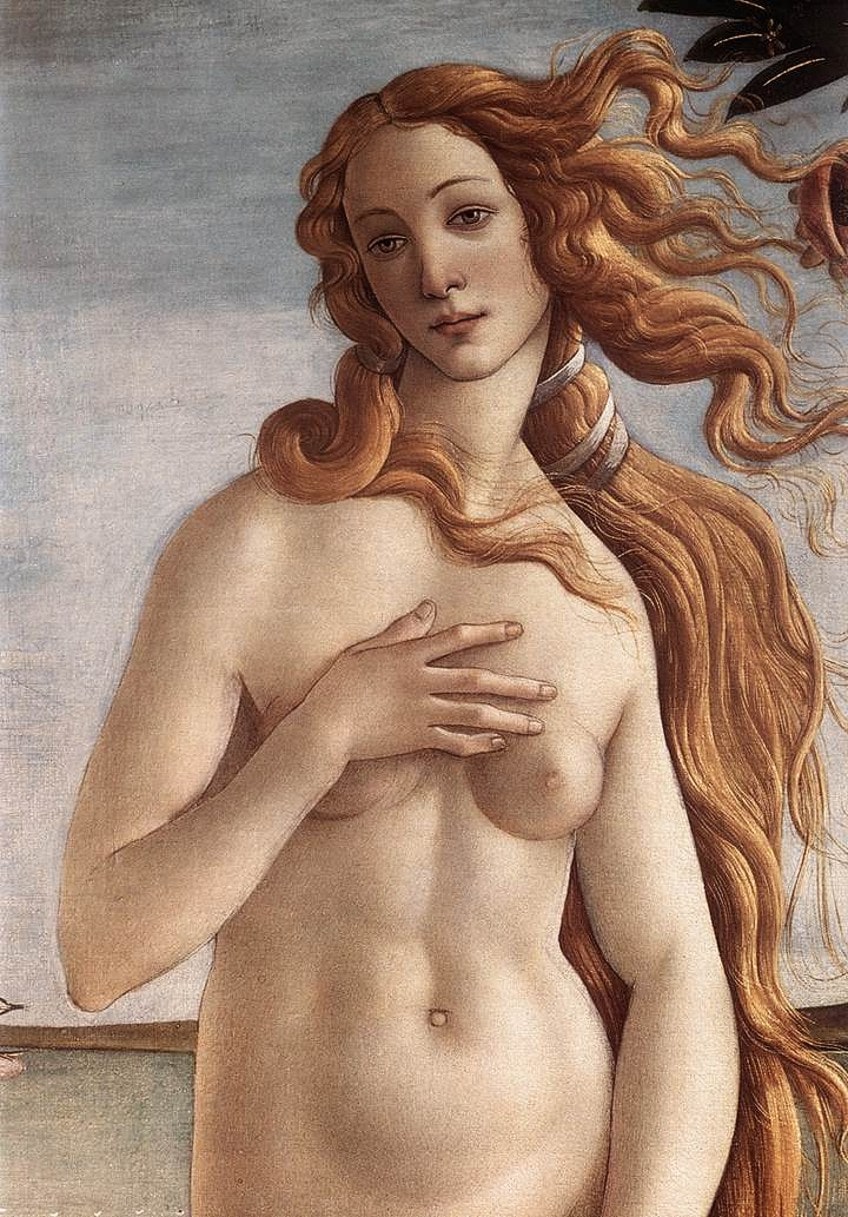 A detail of Venus from Botticelli's The Birth of Venus, c. 1485;Sandro Botticelli, Public domain, via Wikimedia Commons
To Venus' correct (our left) are two figures in the air, busy bravado towards Venus. They accept been identified as the Greek god Zephyr, associated with the westward winds. He was one of the gentler winds, associated with the beginnings of Jump.
Belongings on to Zephyr, her arms wrapped around his waist is Aura, which means "breeze". Information technology could likewise be Zephyr's married woman, Chloris, a nymph of the Spring season and its associated aspects. Both figures appear with beautiful and large wings and billowing drape covering their bodies.
We know they personify the wind and breeze through their action of blowing and the lightly painted lines symbolizing the air current coming out of their mouths.
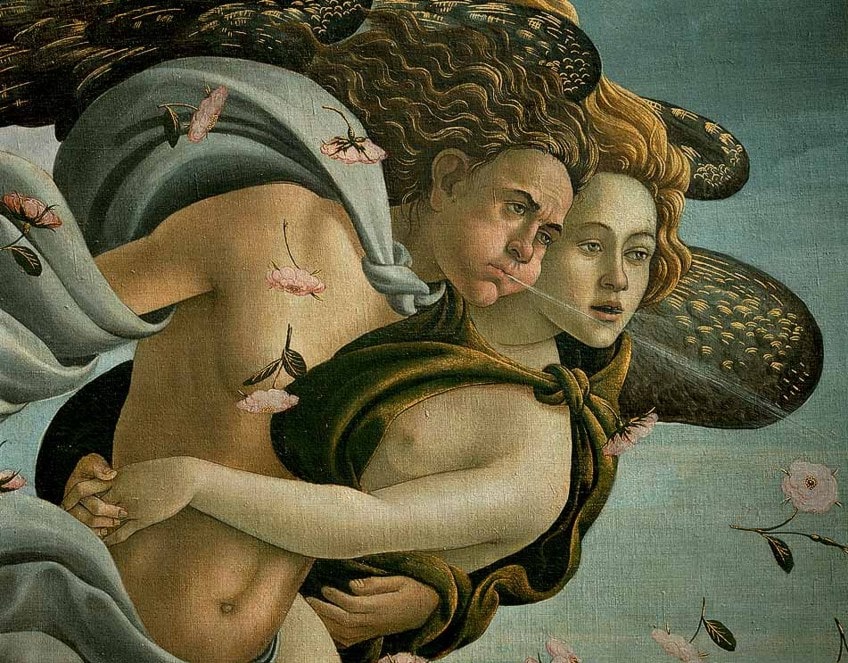 A particular of Chloris and Zephyrus from Botticelli's The Nascence of Venus, c. 1485; Sandro Botticelli, Public domain, via Wikimedia Eatables
To Venus' left (our right) there is another female figure on the shore, waiting to meet her. She holds out a florally decorated cloak to embrace Venus. This figure is identified as one of the Horae, which are the goddesses of the seasons, specifically the Hora of Leap due to the floral patterns and flowers on her clothes.
She also stands very lightly on the grassy shore; some sources as well suggest she may be floating.
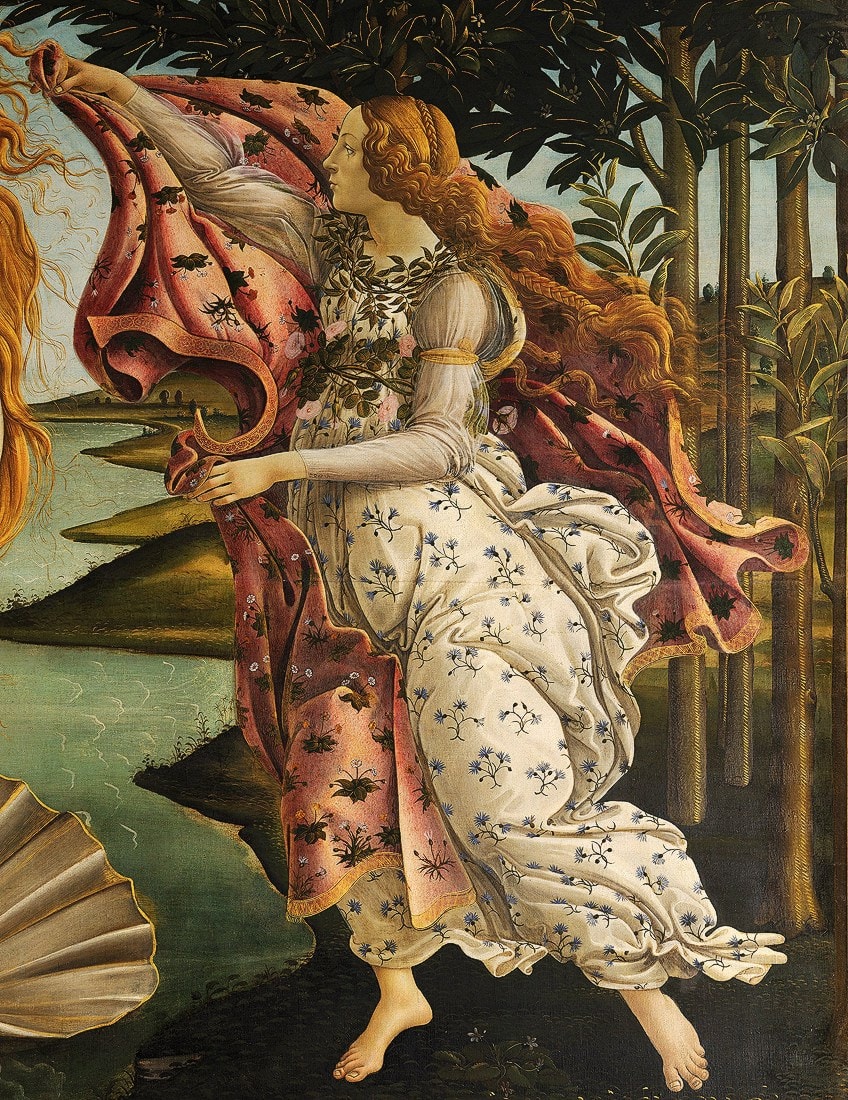 A particular of the Hora holding out a cloak for Venus from Botticelli's The Birth of Venus, c. 1485; Sandro Botticelli, Public domain, via Wikimedia Commons
The surrounding landscape is split betwixt the calorie-free blue of the sea, making up about of the left of the composition. It meets the grassy shoreline on the right-hand side of the composition, which extends into what appears to exist a hilly mural with various scattered trees in the distance. In that location is a wood in the correct foreground where the Hora of Spring awaits. Orange blossoms decorate the trees. Other blossoms are blown towards Venus as she reaches the shore, these include beautiful pink roses with golden centers.
We will notice at that place are various areas of the composition with gilded areas. For case, the shoreline where she volition footstep off to walk, her shell is as well rimmed with gilded, also as the trees and their blossoms.
Technique: Color and Lite
Botticelli used the tempera painting technique, which consists of combining color pigments with a water-soluble medium diluted with a binding medium, which was normally egg yolk. This was dissimilar from fresco paintings; however, many sources indicate that this painting has the "freshness" of a fresco. It has been well-preserved over the centuries.
Botticelli used softer more earthy color tones fix complimentary to the other, for case, the red drapery to the right and the dark-green and blue from the drapery of the two figures to the left. Venus herself is portrayed in the lighter skin tones directly linked with her being a symbol of beauty and perfection.
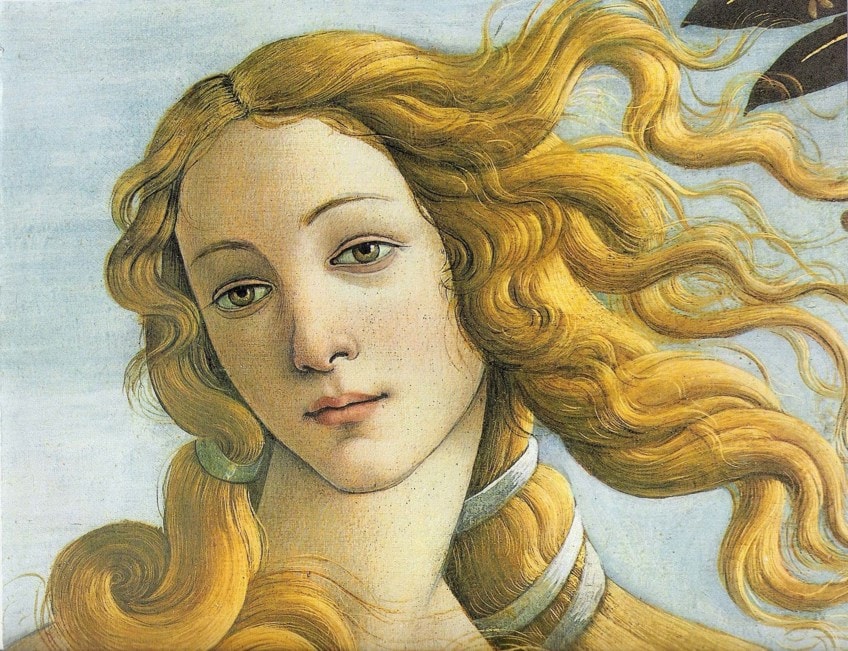 The apply of color and light is illustrated in this close-up of Venus from Botticelli's The Birth of Venus, c. 1485; Sandro Botticelli, Public domain, via Wikimedia Commons
The surrounding mural is also rich in color tones, for example, the cooler colors like the light bluish of the ocean and sky run into the warmer and deeper color tones and shades of dark-green and brown from the state. There is also more shading effectually the right side of the painting as we arroyo the forested surface area.
It nearly appears as if we motion from a lighter side of the limerick to a darker side, from sea to state, from birth to life. This adds depth and chromatic rest to the composition.
Perspective and Line
Botticelli is noted for using dark outlines in the Birth of Venus painting, this takes precedence over the colors used. In this painting, line directly influences perspective. We specifically notice the dark outlines around the figures, the two figures to the left and Venus, all standing with a calorie-free background behind them, which is what creates a dissimilarity. This also emphasizes Venus' milky skin tones and beauty – we could almost say that Venus is venerated inside Botticelli'southward bolder outlines.
The use of darker outlines as well creates a lack of depth to the painting, creating more two-dimensionality. Nosotros run into the darker horizon line in the background and the figures have no shadows, all of which add to a general flatness of the composition.
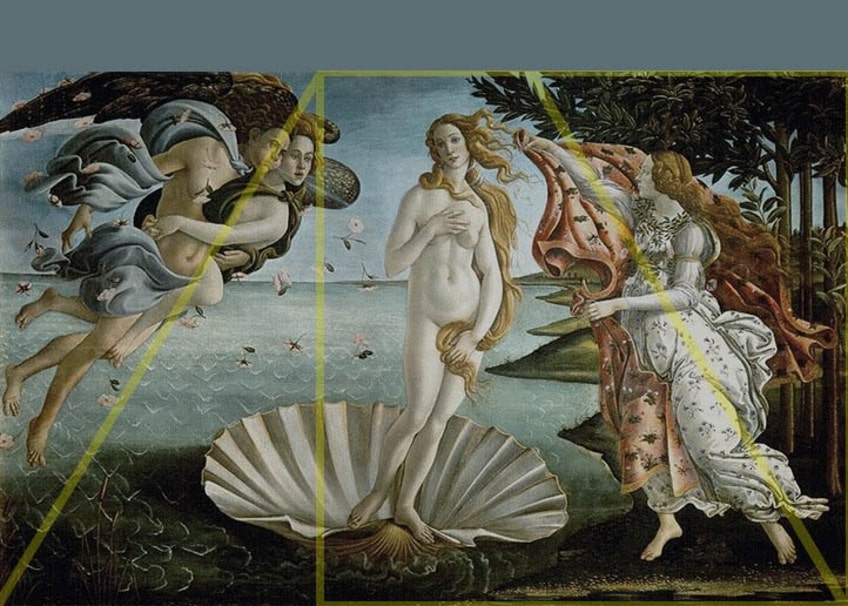 The Golden Ratio as seen in The Birth of Venus (c. 1485) by Sandro Botticelli; Sandro Botticelli, Public domain, via Wikimedia Commons
There are a few elements that advise a sense of depth and movement, such equally in the white chevron-like shapes on the ocean. In the background, these appear virtually similar small dots on the surface of the sea and as nosotros motion closer to the shore it increases in shape and size.
These shapes suggest the idea of waves and create more dynamism to the painting, especially nearly the rim of Venus' beat by her feet, where the water is painted in curling splashes.
Depth is also evident in the landscape; we see this in the green hills and smaller scattered trees in the far background of the composition. This suggests the idea of distance seen from the foreground shore, where almost of our attending is drawn to. If nosotros look closely, the horizon line in the far distance is also a darker outline, and the similar colors of the sky and the ocean creates more flatness, similarly, there is too little sense of depth where the water and land bring together.
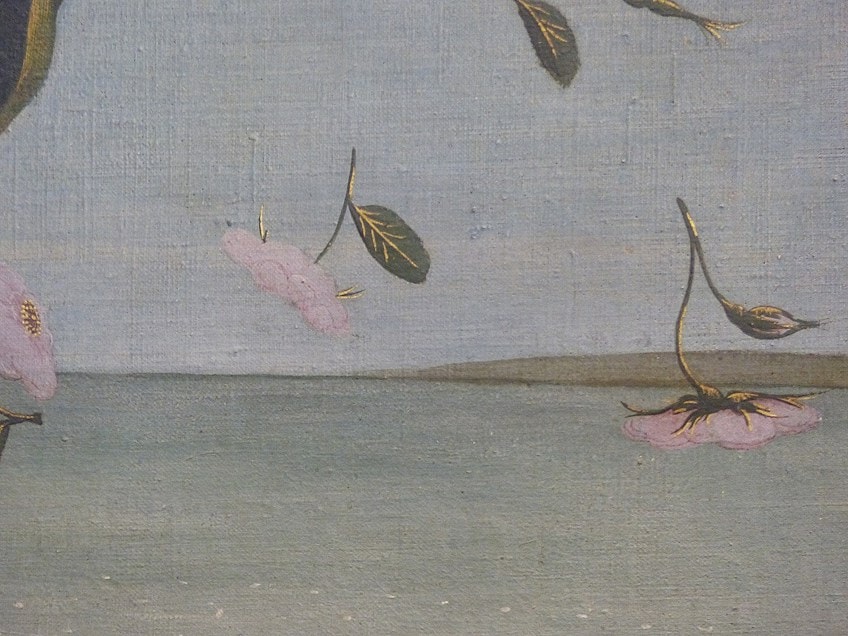 Details of The Birth of Venus (c. 1485) past Sandro Botticelli; Benjamín Núñez González, CC BY-SA 4.0, via Wikimedia Commons
There are other areas where Botticelli uses line to show iii-dimensionality and more dynamism, as in Venus' clamshell and the drape of the figure on the right, as well as the cloak she holds upwards for Venus, which is portrayed in flowing lines suggesting the billowing from the wind to the left. Venus' hair is another instance and one of the primary attractions of this painting, non only depicted in a golden strawberry color merely also long and lustrous, billowing in the wind.
Proportions
The figure of Venus is also portrayed with exaggerated beefcake, overall, her trunk is quite elongated. We see this elongation emphasized in her cervix and in the depiction of her artillery, mostly her left (our right) arm covering her genitalia with her hair.
Furthermore, her opinion is unrealistic as she leans too far to her left side without anything supporting her. In a more realistic setting, she would autumn over. This elongation and inaccurate portrayal of proportion and stance heighten Venus' dazzler and her every bit virtually an otherworldly figure that has simply been given life.
It also points to the stylistic influences on Botticelli at the time, which we volition discuss farther beneath.
Calibration
The painting is big in calibration, measuring i.72 x 2.78 meters. It is also slightly smaller than Botticelli'due south La Primavera (c. 1482 to 1483). If it was the example where this painting was made for the Medici family, it was made to adorn a wall space perfectly fit for private living space compared to public spaces.
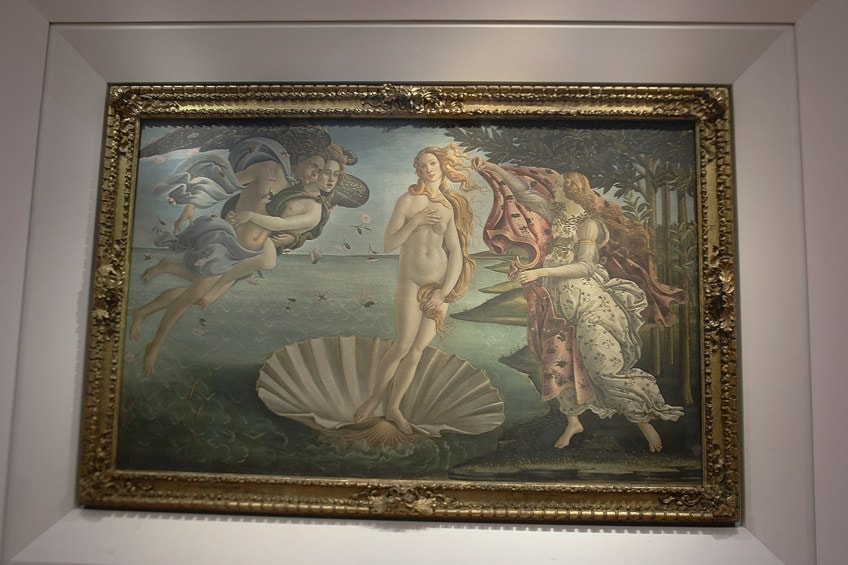 A photograph of Botticelli's The Birth of Venus on a wall in the Uffizi Gallery in Florence, Italy, illustrating its large size; FrDr, CC BY-SA four.0, via Wikimedia Commons
Stylistic Influences
Botticelli did not depict his paintings with the same level of perspectival acuity nosotros run into from other Renaissance artists. He did not prescribe to the heightened sense of naturalism that was so characteristic of the time, his figures appear almost weightless like they are floating.
Some of his stylistic influences that contributed to how he portrayed perspective, infinite, and effigy'south stances in his paintings came from the Byzantine and International Gothic styles.
At that place is a sense of decorativeness in his style with lighter color schemes and arcadian anatomical features, all seeming to focus more than on highly-seasoned to sensory pleasure and aesthetics rather than the idea of staying truthful to nature as we see from artists like Leonardo da Vinci, such as in his rendition of biblical figures like Mother Mary, like his Virgin of the Rocks (1484 to 1486). This is also seen with other contemporaries of Botticelli's like Domenico Ghirlandaio.
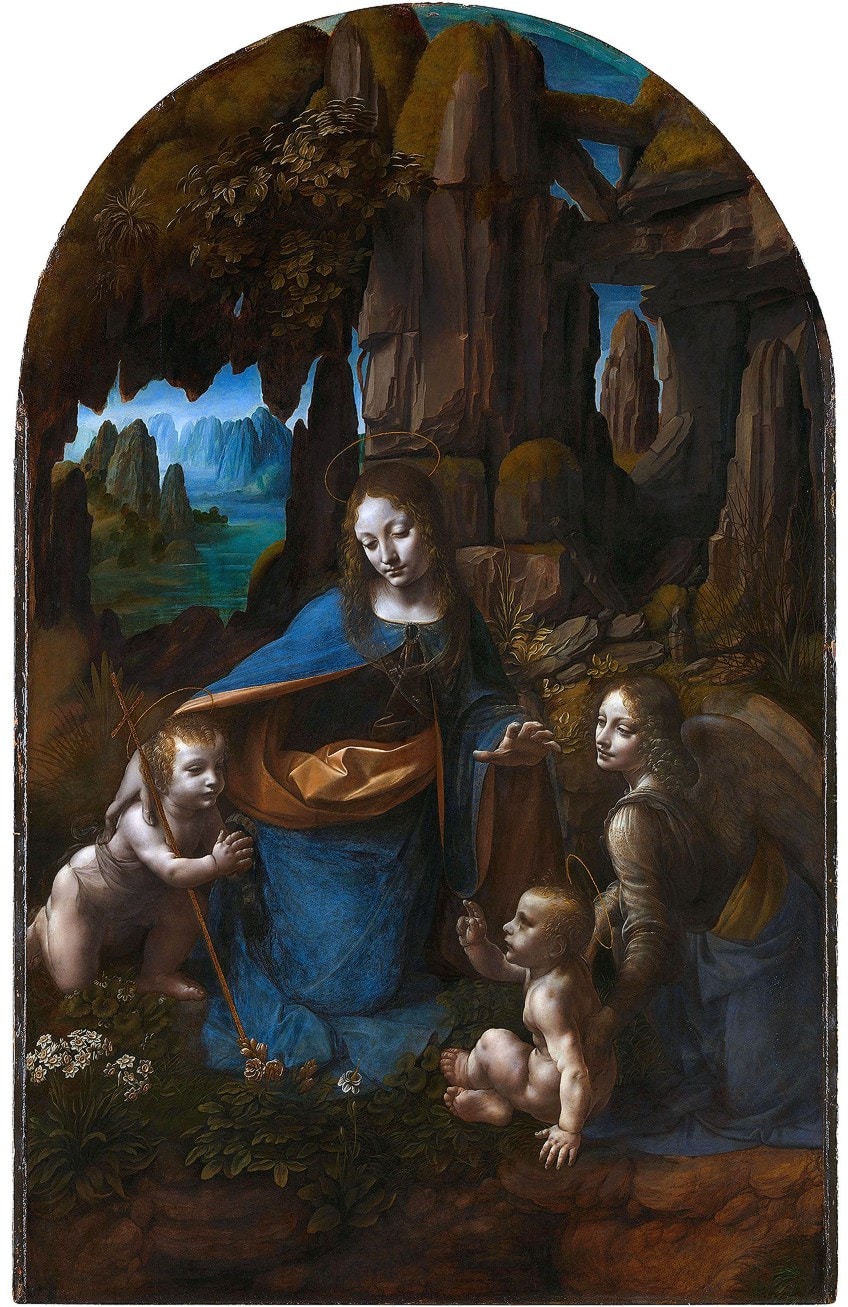 Virgin of the Rocks (1484-1486) by Leonardo da Vinci;Leonardo da Vinci and workshop, Public domain, via Wikimedia Eatables
The figure of Venus and her gestural manner is also believed to have been taken from the sculptural manner Venus Pudica. In fact, Botticelli has crafted his feminine effigy almost like a marble statue painted on canvas. This is too reminiscent of the Classical era'southward Greco-Roman sculptures of female person nudes.
"Venus Pudica" is a descriptor term for a Classical female pose where the female covers her genitalia with one manus and stands in an asymmetrical stance, almost unnaturally.
The way she meekly covers herself, ironically, draws attention to the areas she is roofing. The word pudica originates from the Latin pudenda, which relates to external genitalia or the concept of shame or feeling shameful, all of which are reflected in the countenance of the inconversable Venus depicted above.
 Copy of Aphrodite of Cnidus by Praxiteles, 4th century;Museo nazionale romano di palazzo Altemps, Public domain, via Wikimedia Commons
Nosotros see Botticelli'southward Venus emulating the same features as those of the Aphrodite of Knidos (Cnidus) (c. 4thursday century BC) by the Greek sculptor Praxiteles of Athens. He was one of the first sculptors to portray the female person figure in the nude and was lauded as one of the almost innovative sculptors of his time due to this. Praxiteles'south sculpture depicts Aphrodite holding a bathroom towel in her left hand covering her genitalia with her correct paw, however, her breasts are still exposed.
This sculpture also juxtaposes the classical male person figure in sculpture, which was focused on portraying heroism.
Symbolic Interpretations
It is worth noting that the Birth of Venus by Botticelli has had numerous different symbolic meanings and interpretations. Every bit mentioned higher up, some interpretations come from the Neo-Ideal idea of the Humanist movement during the Renaissance. Below we aggrandize on this a bit more.
Neo-Platonism
Venus was likewise regarded in Neo-Platonic thought as a symbol for physical and spiritual love every bit described by the ancient Greek philosopher, Plato. It is believed that the Birth of Venus painting was meant to arm-twist a contemplative response in viewers. In other words, when viewing Venus, her physical beauty portrayed would be a reminder of the ideas of divine dearest.
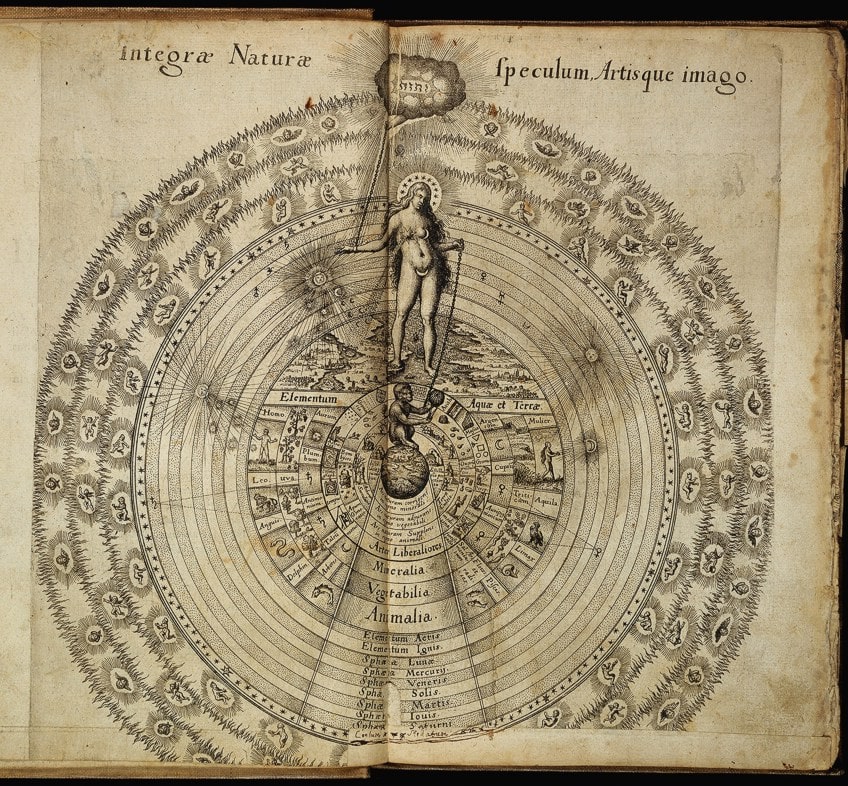 A diagram illustrating the Neo-Platonic principles of the metaphysical, concrete, and technical history of each major and pocket-size cosmos, c. 14/15th century;Meet page for author, CC Past 4.0, via Wikimedia Commons
The Humanist movement allowed a more than open up way of perceiving the world and the subject affair was more than "infidel" compared to the traditional religious bailiwick matter. This type of secularity was deemed acceptable.
This philosophical thought was too reportedly present and practiced within the Medici court, so it is within reason that these to a higher place-mentioned interpretations are interrelated.
Christian Interpretation
It is also important to notation the cultural context in which the Nascency of Venus painting was created, not just was it nestled within a newly emerging cultural awakening that promoted ideas beyond that of the church and bible, but it was still inside a time of strong religious changes and religion would have certainly still played a office.
Some sources likewise depict the Christian interpretation for Botticelli's Birth of Venus and that it is symbolic of and influenced by the Baptism of Christ. It is compared to two other Renaissance paintings to illustrate this idea, namely, Giotto'southward The Baptism of Christ (c. 1305) and Piero Della Francesca's painting of the same name (1448 to 1450).
The structural composition follows Christ equally the central figure, the angels to his correct (our left), and John the Baptist to his left (our right).
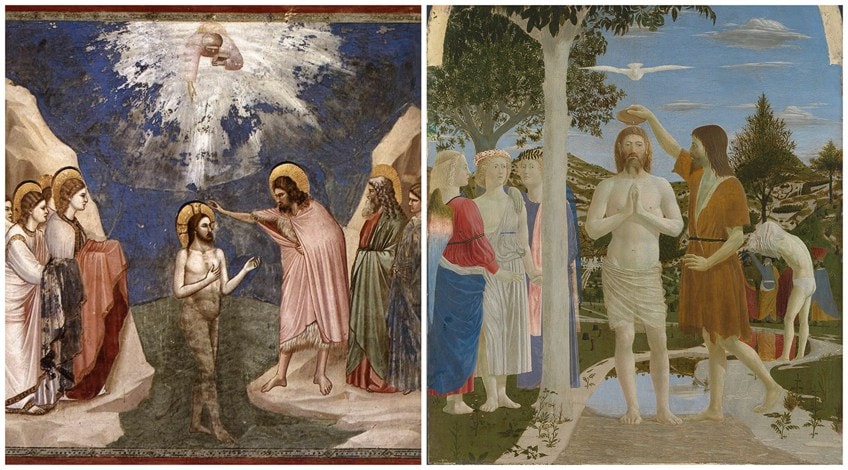 LEFT: No. 23 of Scenes from the Life of Christ: 7. Baptism of Christ (1304-1306) by Giotto di Bondone; Giotto, Public domain, via Wikimedia Eatables | Correct: Baptism of Christ (1448-1450) by Piero della Francesca; Piero della Francesca, Public domain, via Wikimedia Commons
In the Birth of Venus, we see this exact structure, yet, Christ is replaced past Venus, the angels are replaced by the wind god Zephyr and his companion Chloris (or Aura), and John the Baptist is replaced by the Hora of Bound belongings the cloak to encompass Venus.
The gesture of the Hora of Spring and John the Baptist is seemingly like in nature considering both figures (religious and secular) approach the sacred central figure with the intention to adorn or bless them, in this case, a baptism and a protective cloak to cover Venus.
Other Christian interpretations suggest it alludes to the Garden of Eden and Venus as a symbol of Eve'south nudity.
She could likewise exist a symbol of mortality, which is symbolized by the cloak, every bit soon as she puts it on, she becomes mankind and represents the Church building that volition be a conduit for salvation. Furthermore, Venus is also believed by some to be a symbol of Mother Mary, who is also known equally Stella Maris meaning "Star of the Sea", which is farther alluded to by the emphasis on Venus coming from the bounding main. In this case, Venus is regarded as the divine aspect of Stella or "star," and Mary is alluded to by the visual depiction of the sea, or Maris.
For Flattery
Other sources suggest The Birth of Venus painting was fabricated to flatter the head of the Medici family, Lorenzo de Medici. Some believe the figure of Venus was made in the likeness of Simonetta Cattaneo Vespucci, who was the married woman of the Florentine merchant, Marco Vespucci. She is believed to have been born in the town called Porto Venere, which means "Port of Venus" on the Ligurian coast located in Italy.
She was regarded as one of the most beautiful women with the nickname "La Bella Simonetta". Lorenzo de Medici and his blood brother, Giuliano, both held her in high esteem and admiration.
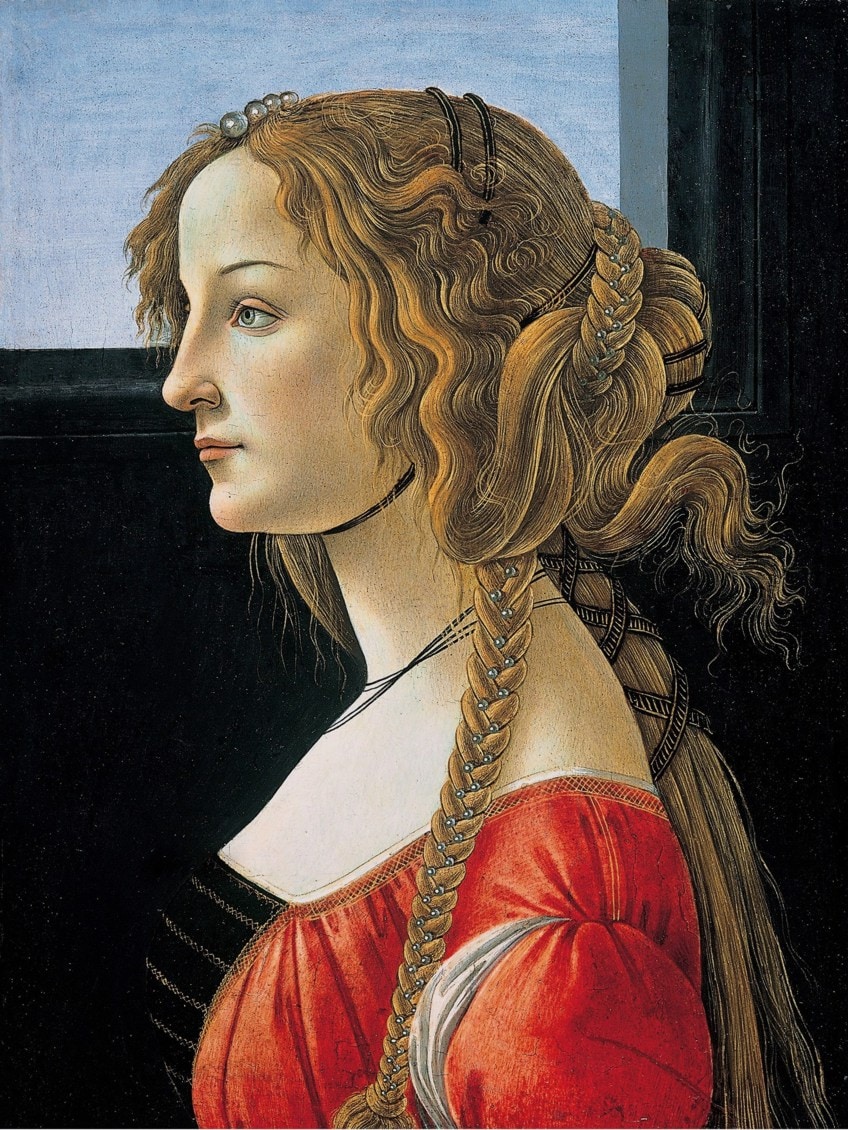 Profile portrait of a immature woman (probably Simonetta) (between 1475 and 1480) by Sandro Botticelli, depicting Italian noblewoman Simonetta Vespucci;Workshop of Sandro Botticelli, Public domain, via Wikimedia Commons
There is also speculation that she was the in a higher place-mentioned Medicis' mistress, which besides alluded to Alexander the Great'southward mistress, Campaspe (or Pancaste) painted by the ancient Greek painter, Apelles of Kos. Botticelli could have been regarded as standing the work washed past Apelles. However, this is only some other historical and political reference inside The Nascency of Venus painting.
A Complex Beauty
Botticelli's Nativity of Venus painting runs as deep every bit the ocean'due south waters where Venus was built-in. While it is regarded equally visually simple to clarify and interpret, giving u.s. all the facts through the placements of the figures and who they are, in that location is an undercurrent in this Early Renaissance painting that suggests and so much more.
The symbolic meaning of this Venus can be considered a circuitous i equally it holds various interpretations that relate to Greco-Roman mythology, Christian religion, politics, history, philosophy (remember Neo-Platonism and the Humanism motion), and undoubtedly wealth and weddings in prominent Italian families.
"The Birth of Venus" painting is an Early Renaissance masterpiece, holding not only the immaculately defined Venus on her gilded scallop shell, arriving on the shores, but too the immaculate artistry of a painter that was not well-known for his time, but who poured out the depths of his soul onto his canvas, giving united states a sensory experience similar no other. Nosotros are unabashedly faced with Venus and her entourage taking the centerstage of this artwork.
Take a look at ourNascency of Venuswebstory hither!
Frequently Asked Questions
Who Painted The Birth of Venus?
The Birth of Venus (c. 1484 to 1486) painting was made past Alessandro Botticelli, who was an artist from the Early Renaissance period in Italia. Although Sandro Botticelli was not as popular as other artists from the Renaissance like the High Renaissance painters Leonardo da Vinci or Michelangelo, he contributed one the most sensory enriching paintings of mythological subject field affair, specifically of the goddess Venus.
When Was The Birth of Venus Painted?
The Birth of Venus was painted effectually 1484 to 1486. This was during the Early on Renaissance period in Italy, a period that spanned the 1400s. Information technology was also referred to every bit the Quattrocento period, which was later on the Eye Ages and Proto-Renaissance menses and preceded the latter role of the Renaissance called the High Renaissance.
Where Is The Birth of Venus?
Presently, The Birth of Venus (c. 1484 to 1486) painting is housed at the Uffizi Gallery in Florence, Italy. It is believed that the painting was requested by the Medici family as a wedding present. They commissioned Alessandro Botticelli, who is the artist of the Birth of Venus. Some sources report it was housed in the Villa Castello until 1815, which belonged to Cosimo I de Medici, this is where La Primavera (c. 1482 to 1483) was as well housed.
Where Was The Birth of Venus Painted?
Information technology is believed that after Sandro Botticelli worked on frescoes for the Sistine Chapel in Rome in 1481, he returned to his city of nascence, Florence, where he started painting more secular subject thing. This included mythological subject matter from the Greek and Roman era. It was here that Botticelli was commissioned to paint The Birth of Venus, which was from 1484 to 1486.
Source: https://artincontext.org/the-birth-of-venus-botticelli/
0 Response to "Would Botticellis Birth of Venus Be Classified as an Abstract Work if Art"
Post a Comment